Tolly Good, Sir
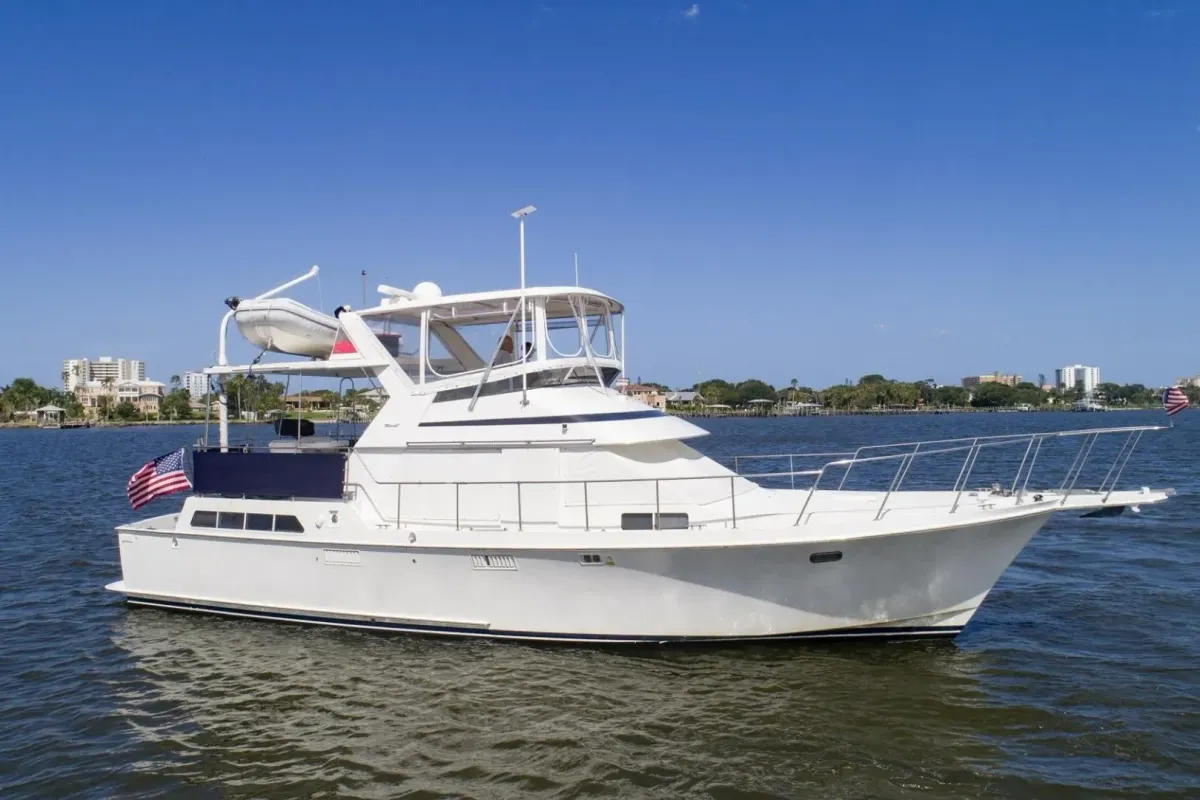
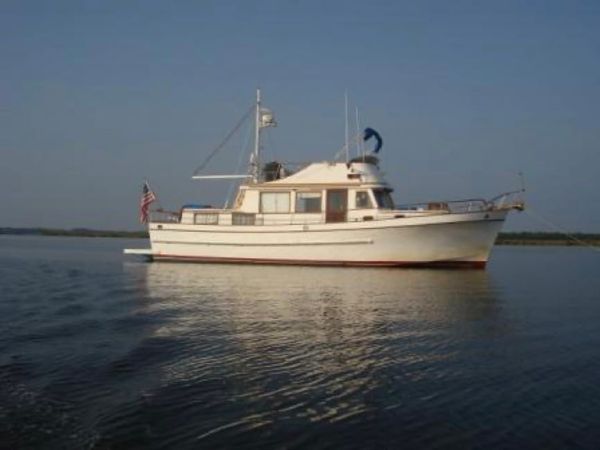
There are many packaging challenges inherent in the 40-50 foot motor yacht class, and few manufacturers resolved them as cleanly as Tollycraft did with their 44-foot Cockpit Motor Yacht.
Ideally, a mid-size cruising yacht would have it all: a flybridge, a full-beam owner’s stateroom, a water-level cockpit for fishing, and an aft deck for socializing. The difficulty is that all of these components are competing for space in the boat’s profile with only so much length along which to distribute them. The results are often quite ungainly.
Many designs don’t even try to cram everything in - sedan yachts like Grand Banks’s Eastbay series are beautiful and have a large, functional cockpit, but often don’t have a flybridge, never an aft deck, and the owner’s stateroom is up forward with the guests. The classic trunk cabin design gains the aft cabin and flybridge but only a small deck aft suitable for neither serious fishing or socializing.
Renowned naval architect Ed Monk Jr was behind this very thoughtful Tollycraft design, and it’s worth diverting to consider how he did it. First, the hull is relatively low with modest freeboard and a continuous sheer line. The foredeck is also long and low. These proportions give the impression of a longer, slimmer craft than 44 feet might suggest, and the trim, elegant foundation is critical to setting up visual space for what could be a cluttered superstructure.
The aft-deck and cockpit - where this design often falls apart - is very cleanly integrated into the overall superstructure. The trick is to reduce the appearance of too many levels on a boat that has many levels; if you don’t, a bulky pagoda profile appears that makes for an awkward boat.
The Tolly does this several ways: the lower edge of the flybridge brow (the molding that provides shade to the forward pilothouse windows) transitions straight into the railing of the aft deck, and the cockpit gunwale begins the continuous sheer line that carries all the way to the pulpit. That’s two horizontal lines where there could have been four!
The aft deck’s hardtop is thin, and appreciably lower than the flybridge canvas. While the three-quarter angle is her least flattering, the Tolly avoids the “small kid with a big backpack” aesthetic common to the class. Ed Monk is famous for a reason.
With aesthetic objections to the aft-deck design tamped down, the advantages can shine. It’s got two cabins - separated by the engine room - and each gets its own head. The salon is bright and uncluttered by the galley, which is down along with a dedicated dining booth. For longer cruises, that’s huge. While some prefer the galley up, either to create space for a bunk room or to keep the cook in the salon’s social zone, the galley down keeps the food out of the living space. Between mealtimes, the booth becomes a place to read, spread out charts, or work on a laptop with a smidge of privacy.
This model includes the optional lower helm; it’s small, but the ability to pilot the boat from below in inclement weather is a must-have for any long-range cruising.
There are three distinct outdoor spaces - the flybridge, the aft deck, and the cockpit - very impressive for a 44-foot boat. While no single space is gigantic, each could comfortably host four or five people. The ability to conduct real - if not tournament-level - fishing operations is rare in a motor yacht.
There are compromises, chief among them a tight engine room with primary access through hatches in the salon sole, although there is a crawl-in door built into the steps down to the galley. You have to be careful to keep the salon clean during major maintenance, and it’s not easy to conduct routine engine checks. Some boats of this size offer a third stateroom, so if you’re regularly cruising with more than four, it may not work.
This particular example is powered by Caterpillar 3208TAs, extremely durable engines that will chug along very efficiently at 8-10 knots or push the boat to a reported 19 knot cruise with a mid-20s top end - very fast for this type of motor yacht. There are 6,500 hours on these engines, which is a lot. However, they’ve received a lot of recent service, and these Cats have been known to accumulate significantly more hours when well maintained. A thorough engine survey is required in any event.
A twenty-knot cruise is remarkably useful, especially measured against a similarly sized (and styled) trawler yacht. Pardon the math: a 20 knot, two hour cruise gives you a cruising area of 5,000 square nautical miles as compared to the 8-knot trawler’s 800 square nautical mile area. That’s a six-fold improvement. If you’re in a destination-dense area like the Chesapeake or Pacific Northwest, that opens up a lot of day trip options, let alone weekend voyages.
The boat appears well-maintained; for a boat of its vintage, the maintenance record means more than simple age. A neglected fifteen-year-old boat is often worse than a well-loved thirty-year-old model.
This is a very versatile, comfortable cruiser with a surprising turn of speed. It’s small enough that a couple could get underway for an afternoon cruise, but spacious enough to live onboard for weeks - even full time. The price for the capability is remarkable; in 2026, you can spend $120k on a pickup truck that won’t do a tenth of what this Tolly was built for.
https://www.yachtworld.com/yacht/1988-tollycraft-44-cockpit-motor-yacht-10258284/
Listing broker: Paul Denton, pd@LukeBrown.com of Luke Brown Yachts